Cold Case Investigations
What is a Cold Case?
Cold case investigations re-examine a missing persons disappearance after early leads have stalled or gone unanswered. These cases focus on reviewing records, timelines, and evidence with fresh perspective and updated methods. Investigators may revisit witness statements, analyze old data in new ways, or apply modern technology that was not available at the time. Progress often comes from careful attention to overlooked details rather than speed.
The objective is to uncover new information that can move the case forward and bring clarity to long-standing questions.
Our Cold Case Investigation Process
We will review a copy of the initial police report and re-interview the people police officers initially interviewed.
Our investigators will conduct telephone or physical interviews with family members, friends, neighbors, and co-workers of the Missing Person.
We will create and disseminate posters of the missing person, going door to door, within the missing person’s neighborhood or by mass mail.
Why Hire Known Stranger Investigations, LLC, for Cold Case Investigations?
- Known Stranger Investigations, LLC, will re-start the investigation with a new set of eyes.
- Our Investigators will re-interview all parties listed in the police report.
- People known to the missing person may provide pertinent information which they were previously reluctant to provide to law enforcement officers.
- People are known to be scared of law enforcement, do not want to be viewed as a “tattle tale,” and are more likely to speak openly with relevant information to a private investigator.

The Goal of Cold Case Investigations conducted by Known Stranger Investigations, LLC.
- Assist families and law enforcement in the search of a non-criminal missing person.
- We will try to bring closure to the family members of the missing person by continuing search efforts.
- Remove the missing person from the missing person’s database.

Testimonial
“Thank you so much for everything that you did to find our daughter. My family and I are very grateful. Without your help I don’t think there is a way we could have found her… After four years of not knowing, now I have peace of mind.”
Frequently Asked Questions (FAQ's) on Cold Case Investigations
What is a cold case investigation for a missing person?
A cold case investigation involves the re-examination of an unsolved missing person case where all original investigative leads have been exhausted.
When is a missing person case typically classified as a cold case in California?
A missing person case is typically classified as “cold” after a period of inactivity ranging from one to three years.
What does it mean when a case is considered to have exhausted all leads?
A case is considered to have exhausted all leads when every viable tip, witness, or piece of physical evidence known at the time has been fully investigated without locating the missing person.
Are cold cases legally closed in California?
No. Cold cases remain legally open and on the books, even if they are inactive.
Can a cold case be reactivated in California?
Yes. A cold case can be reactivated at any time if new information, tips, or forensic breakthroughs become available.
Why do law enforcement agencies prioritize certain cold cases?
Many agencies prioritize cold cases where there are extenuating circumstances or a strong suspicion that the disappearance involved foul play or homicide.
Why are original case files reviewed in cold case investigations?
Specialized investigators review original reports to identify overlooked discrepancies, missed leads, or investigative gaps from the initial inquiry.
What databases are used in California cold case investigations?
Investigators commonly use databases such as the National Missing and Unidentified Persons System (NamUs) and CODIS to cross-reference missing person reports with unidentified human remains across jurisdictions.
What are Cold Case Units?
Cold Case Units are specialized law enforcement teams dedicated exclusively to long-term unresolved cases to ensure they continue to receive investigative attention.
Who typically works in Cold Case Units?
These units are often staffed by experienced detectives and, in some cases, retired officers with extensive investigative backgrounds.
Why do families sometimes hire private investigators for cold cases?
Families may hire private investigators because they can dedicate full-time attention to a single case, unlike law enforcement agencies that must prioritize active emergencies.
Statistics on Missing Adults in California
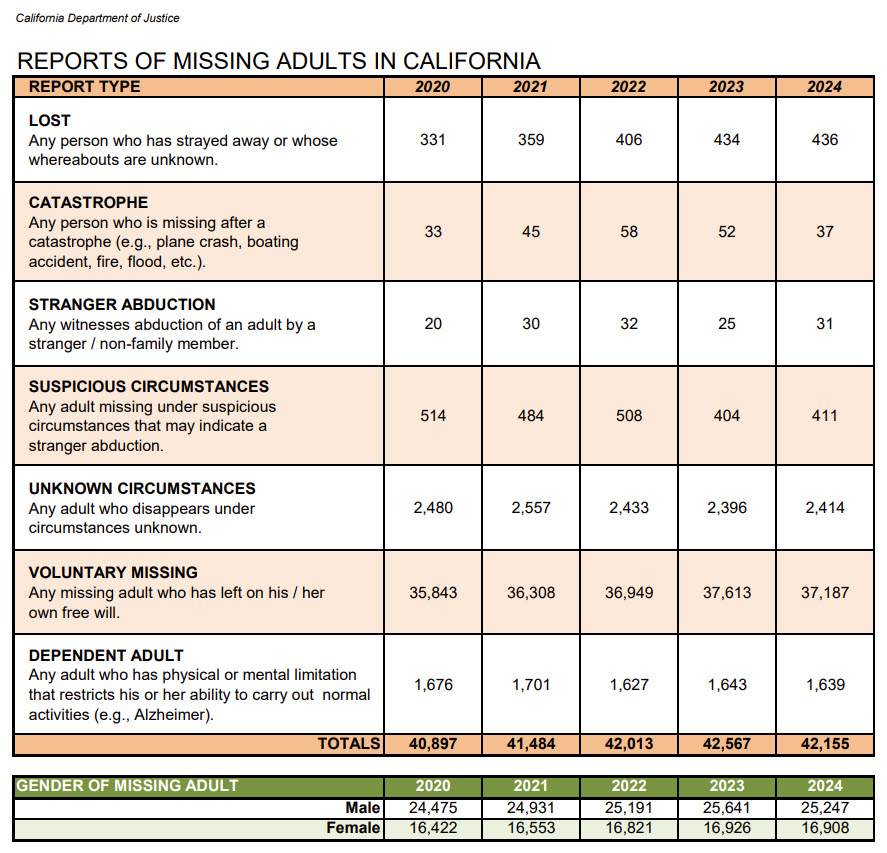
In the State of California, the Department of Justice is responsible for maintaining statistics on missing adults. In 2024, there were:
- 1,639 Dependent Adults reported missing
37,187 Voluntary Missing Adults who left on their own free will
2,414 who disappeared under Unknown Circumstances.
Below is a graphic of the 2024 Annual Missing Adult Report: