Suicidal Person Searches

What is a Suicidal Search?
Suicidal person searches center on finding individuals who may be experiencing a severe mental health crisis. These searches often begin after warning signs such as distressing messages, sudden withdrawal, or statements of hopelessness. The focus is not only on location, but on approach—ensuring the person is found in a way that reduces fear and escalation. Responders prioritize calm communication, situational awareness, and an avenue for support.
The objective is to intervene safely, stabilize the individual, and guide them toward immediate professional care.
Our Suicidal Person Search Process
Investigators will attempt to contact the suicidal person, as well as, the family members, friends, and coworkers of the suicidal person. In addition, Investigators WILL NOT generate, nor disseminate posters of suicidal persons. If the suicidal person is an adult, they have a right to privacy. The suicidal person may have made threats of suicide (attention getting for help) and left the residence for a few days to cool down and regain composure. It is the Investigators’ goal to gain the trust of the suicidal person with the hopes of the suicidal person contacting the Investigators without having any fear. When the suicidal person contacts Investigators, an interview will be conducted, a meeting will be set with the person and law enforcement to remove the suicidal person from the missing person’s database, and referrals for counseling services may be provided.
Known Stranger Definition
People close to the Suicidal Person, such as, immediate family members, spouses, children, siblings, loved ones, friends, coworkers, and neighbors can view the Suicidal Person as a “Known Stranger.” In most cases, these people did not notice any negative changes in the Suicidal Person and presented the Suicidal Person as having positive characteristics and an upbeat personality.
They did not know the Suicidal Person was in any pain (physically/emotionally/mentally) and did not see any attributes or warning signs indicating the person intended to commit suicide. People close to the Suicidal Person were shocked and in disbelief that the person could follow through with such an act. They now view the Suicidal Person as a “Known Stranger,” because they could not believe they overlooked that part of the Suicidal Person’s intention and have no explanation as to why the person committed suicide.

What are the signs of a suicidal person?
People who leave home and threaten to end their lives are called “Suicidal Persons.”
Having personally interviewed people known to the Suicidal Person, most were shocked to learn the person was missing and threatened to commit suicide.
In some cases, suicidal people may verbally express thoughts of suicide to people close to them. Some Suicidal Persons may demonstrate physical traits of withdrawal, depression, loss of interests, isolation, and excessive alcohol or drug abuse. In many cases, unaddressed mental health can be an underlying factor contributing to the threats of suicide or actual suicide.

Testimonial
”… Although this particular juvenile is a habitual runaway, she has a multitude of serious problems to include being bi-polar, depressed and at times suicidal…”
“I was highly impressed with your knowledge of the complexities of teenage runaways and the systematic procedures you utilized in contacting family members, friends, combined with your dedication and commitment to travel throughout the San Francisco Bay Area in an attempt to locate this ‘At Risk’ juvenile.”
Your four-day investigation successfully concluded when you made covert arrangements to meet the runaway juvenile. The juvenile was eventually united with her mother and safely returned home.
“I am happy to inform you that the juvenile is currently receiving the medical attention required to ensure her future safety…”
Frequently Asked Questions (FAQ's) on Suicidal Person Searches
Is there a 24-hour waiting period to report a missing person in California?
No. California law does not require a 24-hour waiting period to report a missing adult.
What should I do immediately if a suicidal person goes missing in California?
Call law enforcement immediately to file a missing person report. Emphasize that the person may be suicidal so officers can respond using appropriate mental-health and crisis protocols.
Who should I contact to report a missing adult in California?
Contact your local police department or sheriff’s office right away.
Is there a national system that can help locate a missing suicidal person?
Yes. The National Missing and Unidentified Persons System (NamUs) is a national database used to help locate missing individuals.
Should I wait before calling the police if the person is suicidal?
No. You should not wait. A potentially suicidal person should be reported missing as soon as they are believed to be gone.
What information should I provide to police when reporting a missing suicidal person?
Provide a detailed physical description, recent photographs, clothing last worn, possible destinations or past locations, medical or mental-health information, and any medical alert or tracking details.
What suicide-related risk information should be emphasized to law enforcement?
You should clearly explain whether the person is a danger to themselves, has made suicidal statements, has access to means, or has a recent history of crisis or hospitalization.
Should I obtain a copy of the police department or sheriff’s office missing person report?
Yes. Obtain the report number, a copy of the report, the officer’s name, and the officer’s telephone number.
Should I make multiple copies of the police report?
Yes. Make multiple copies of the police report. Every organization that assists in search for the Suicidal Person will require a copy of the missing person’s report.
Why is it important to tell police that the missing person may be suicidal?
Stating that the situation involves suicide risk changes how officers respond, allows the use of crisis-intervention protocols.
Who else should be notified besides the police in California?
You should notify the person’s mental-health providers, such as their case manager, clinic, therapist, or recent hospital, as they may have protocols in place or relevant information.
California Department of Justice at 1-800-222-FIND (24 hour nationwide toll-free Hotline) or (916) 210-3119 or at missing.persons@doj.ca.gov.
What support organizations can families contact in California during this situation?
Families can contact the National Alliance on Mental Illness (NAMI) helpline for guidance and emotional support.
Who in the community should be notified to help locate the person?
You may notify friends, neighbors, and others who might know the person’s habits, street names, or possible whereabouts.
What local places should be checked when searching for a suicidal person?
You should check local shelters, hospitals, and locations which have significant meaning to the person, understanding that privacy laws may limit the information they can share.
What resource should be used for immediate suicide crisis support?
You can call or text 988, the Suicide & Crisis Lifeline, for immediate support for yourself or if you believe the missing person is suicidal.
When should a private investigator be considered in California?
If traditional methods are not producing results and resources allow, you may consider hiring a private investigator.
Statistics on Suicidal Persons in California
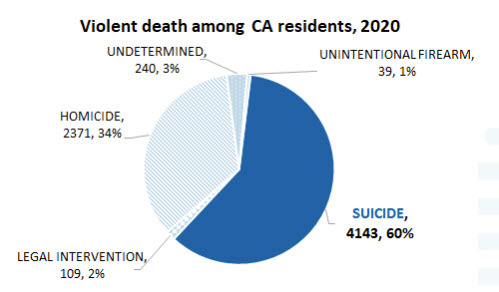
The California Department of Public Health is responsible for maintaining statistics on suicidal persons. In 2020, there were 6,902 violent deaths to Californians, of which, Sixty percent of these (4,143) were deaths due to suicide. The rate of death by suicide was 10.4 suicides per 100,000 individuals, meaning there were nearly twice as many suicides as homicides. To learn more about Suicide Prevention, download the CalVDRS 2020 Suicide Fact Sheet.