
Runaway Searches

What is a Runaway Search?
Runaway searches are typically efforts to locate children and teenagers who have left home or care without approval. These cases are time-sensitive, because each passing hour can increase danger. Youth who are on their own may face harm from unsafe places, manipulation, or lack of basic needs. Successful searches depend on quick coordination between families and law enforcement.
The priority is clear: find the youth, make sure they are safe, and connect them to stable support as soon as possible.
Our Runaway Search Process
We will contact siblings and close friends of the runaway asking that they inform the runaway of our active search. In many cases the runaway left home due to family conflict. Our investigators have heard just about every reason why runaways left the home. We will not be shocked or embarrassed to hear why the runaway left. Our goal is to help regardless of the circumstances. We are here to find, as well as, help the runaway. Once located, our Investigator will interview the runaway. Then law enforcement will be called. All three parties will work together to remove the runaway from the missing person’s database and help search for family counseling services.
Known Stranger Definition
Having personally located many runaways (via telephone or missing poster dissemination) and conducted interviews with them as to the reasons why they left the home; the following information is being presented:
Runaways can view residents in their home- biological parents, stepparents, guardians, caretakers, parent’s boyfriend/girlfriend, parent’s roommates, siblings, and extended family members as a “Known Stranger,” due to having incurred verbal, mental, physical, or sexual abuse by them.
The term “Known Stranger” references the act imposed upon the runaway by someone close to them, not the time frame they have been acquainted with one another. The runaway questions how a once trusting, close, person could engage in such inappropriate behavior and the runaway now views that person as a “Known Stranger.”

Why do Youth Runaway?
Many runaways leave their homes primarily due to verbal, mental, physical, and sexual abuse. However, there are many other reasons why children run away from home:
- divorce
- unstable home life
- violence in the home
- mental health of parents or runaway
- drug/alcohol abuse of parents or runaway
- runaway engaging in premarital relations
- family not approving of race/religion/age of runaway’s significant other
- pregnancy
- family not approving of runaway’s sexual orientation
- bullying at school or on-line
- runaway is wanted by law enforcement
- runaway wants to leave a small town for the city life experience.

Frequently Asked Questions (FAQ's) on Runaway Searches
Is there a 24-hour waiting period to report a runaway teenager in California?
No. California law does not require a 24-hour waiting period to report a missing child. A runaway minor can be reported missing immediately.
What should I do first if my teenager runs away in California?
You should take immediate action by contacting local law enforcement.
Who should I contact to report a runaway teenager in California?
Contact your local police department or sheriff’s office right away.
What information should I provide to California law enforcement?
Provide a detailed physical description, recent photographs, known medical or mental health concerns, and information about what your child was wearing when they went missing.
Should I obtain a copy of the police department or sheriff’s office missing person report?
Yes. Obtain the report number, a copy of the report, the officer’s name, and the officer’s telephone number.
Should I make multiple copies of the police report?
Yes. Make multiple copies of the police report. Every organization that assists in search for your child will require a copy of the missing person’s report.
What is the National Crime Information Center (NCIC), and how is it used in California?
The National Crime Information Center (NCIC) is an FBI-managed database used by California law enforcement agencies to help locate missing children nationwide.
How quickly should a missing child be entered into NCIC in California?
You should request that law enforcement enter your child’s information into the NCIC database within two hours of filing the report.
Who else can assist with runaway cases in California?
Parents and guardians in California can contact the National Runaway Safeline (NRS) and the California Missing Children Clearinghouse (MCCH).
What role does the National Runaway Safeline play?
The National Runaway Safeline can act as a communication bridge by passing messages to your child if they contact the hotline at 1-800-RUNAWAY (786-2929)
What role does the California Missing Children Clearinghouse play?
The California Missing Children Clearinghouse (MCCH) maintains a toll-free telephone hotline (1-800-222-FIND) 24-hours-a-day, seven-days-a-week to receive information and inquiries regarding missing children. It relays this information to the appropriate law enforcement agencies. The California MCCH may also be reached at (916) 210-3119 or by Email at missing.persons@doj.ca.gov.
What digital activity should I review when searching for a runaway teen?
Review phone logs, text messages, email accounts, and social media platforms such as X, Instagram, TikTok, and Snapchat for clues about recent conversations or plans.
What physical locations or belongings should be searched?
Search your child’s bedroom and personal spaces for diaries, notes, maps, and missing items such as cash, identification, clothing, backpacks, or electronic chargers.
Who should I contact among my child’s peers and school community?
You should contact close friends, classmates, teachers, counselors, and school administrators.
Why might friends withhold information in runaway cases?
Friends believe they are doing a good deed and protecting the runaway by withholding information from adults and authorities.
What local places should be checked in California?
Check parks, shopping centers, transit stations, beaches, shelters, and locations your child is known to frequent.
When should I consider hiring a private investigator in California?
If resources allow, you may consider hiring a licensed California private investigator who specializes in locating runaway youth.
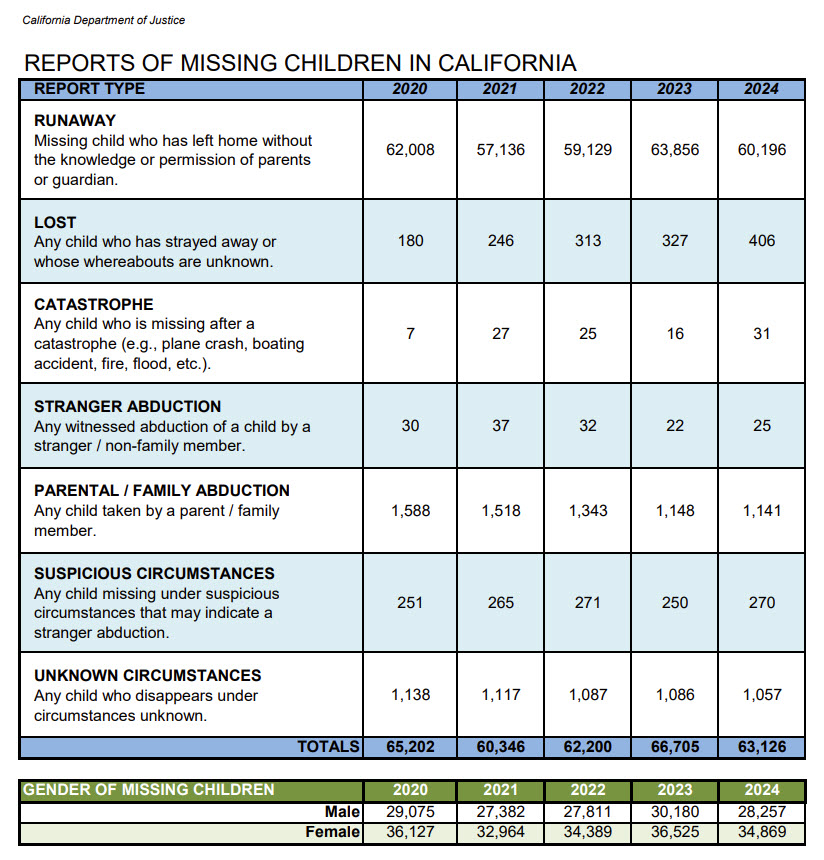
Statistics on Runaway Youth in California
In the State of California, the Department of Justice is responsible for maintaining statistics on missing children. In 2024, there were 60,196 children in California counted as runaways. Below is a graphic of the 2024 Annual Missing Children Report:
Take Action Today
If you are facing the distress of a missing loved one, contact us today to discuss how our dedicated team can help.